Retatrutide Peptide
You've probably already heard of GLP-1 medications like Ozempic taking over the market. However, there is a new and...

Last updated: May 11, 2026
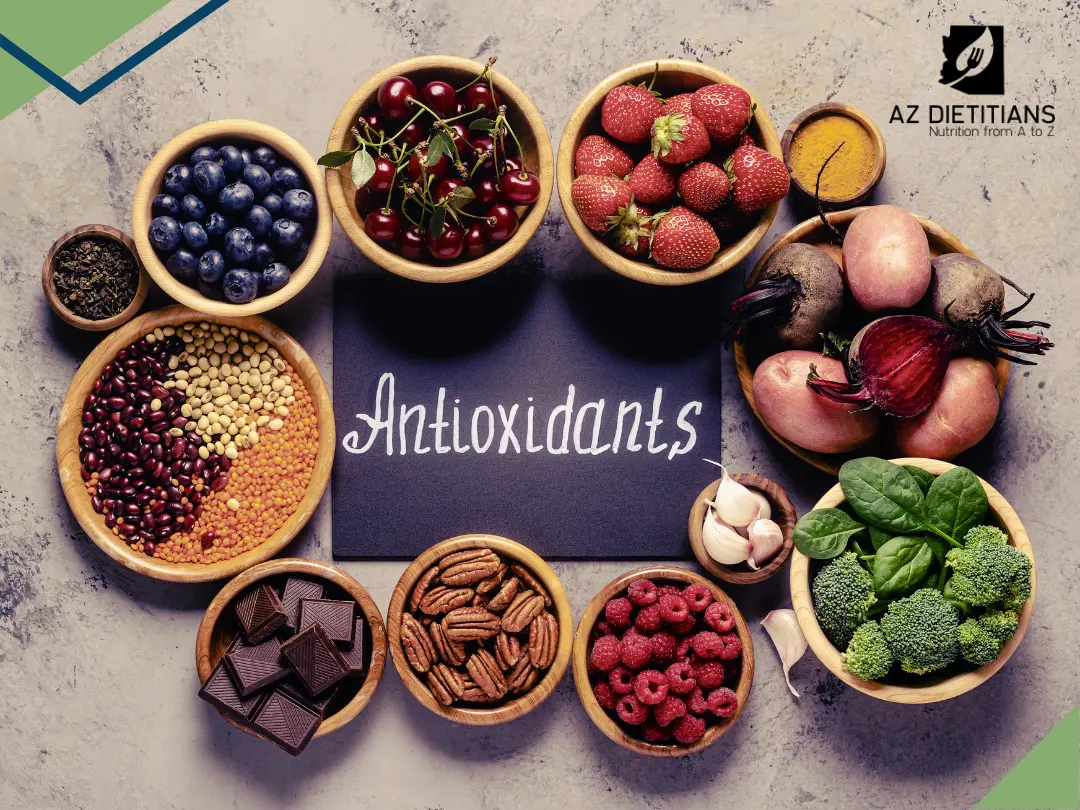
As people age, discussion of chronic disease becomes more and more common. Often, doctors and health professionals like Registered Dietitians recommend various lifestyle choices that can lower the risk for developing chronic disease. But what if you knew that adding one simple thing to your diet could change the whole game? What might this magical thing be? Antioxidants!
Disruptions in our body can cause the creation of microscopic particles called free radicals, which are small unstable molecules. To become stable, they take particles called electrons from the cells that make up our bodies, causing damage and breakdown. This breakdown is known as oxidation. In small numbers, free radicals can be managed by our bodies, but a buildup of free radicals can lead to what is known as oxidative stress.
A practical way to think of oxidative stress is to envision our bodies rusting on a microscopic level. Rust breaks down and eventually destroys metal and in the same way, free radicals break down and can even destroy our cells. Oxidation and the creation of free radicals can result from a variety of things including internal natural everyday processes as well as external environmental factors. Below are some common processes and exposures that create free radicals in our bodies:
Natural Processes:
Environmental Factors:
Oxidative stress slowly degenerates our cell structures and causes a lot of wear and tear on our bodies. This can be linked to the development of many types of chronic and degenerative diseases including cancer, cardiovascular disease, autoimmune, arthritis, Parkinson’s, and Alzheimer’s. It may be discouraging to find out that your body is constantly making free radicals, but there is good news for you! One word: Antioxidants!
Antioxidants are molecules capable of donating electrons to free radicals, making them stable, while maintaining their own stability. Basically, antioxidants neutralize free radicals so that they can’t cause oxidative stress on our cells. However, in the process of neutralizing free radicals, antioxidants are used up making it necessary to have a constant supply. Our bodies naturally make antioxidants, which can counteract the constant creation of free radicals. However, antioxidants can also be consumed through our diet!
Common antioxidants found in food are:
Consuming foods rich in antioxidants can help the decrease the overall amount of oxidative stress in our body. Research has shown that this has a positive effect in the prevention of chronic disease and promotes overall health!
What does it look like to practically consume antioxidant rich foods? Start by knowing which foods contain them, and then begin to incorporate them into your diet. Below is a list of antioxidants and the foods that contain them:
Now that you have an idea of some antioxidant rich foods, go in search of recipes that include them in the ingredients, or take your creativity in the kitchen to a new level by creating your own antioxidant rich meal! Have fun with it and know that you are supporting your health along the way!
References
Pham-Huy, Lien Ai et al. “Free radicals, antioxidants in disease and health.” International journal of biomedical science : IJBS vol. 4,2 (2008): 89-96.
Willcox, Joye K et al. “Antioxidants and prevention of chronic disease.” Critical reviews in food science and nutrition vol. 44,4 (2004): 275-95. doi:10.1080/10408690490468489
Last updated: May 11, 2026
AZ Dietitians offers in-person and virtual appointments for Arizona clients. Now offering telehealth services for clients in Colorado, Utah, and California.
You've probably already heard of GLP-1 medications like Ozempic taking over the market. However, there is a new and...

Fasting can affect women differently depending on factors like age, activity level, hormonal health, and reproductive status. Learn what research says about intermittent fasting, PCOS, menstrual health, bone density, and more.
Could the ultra-processed foods you eat regularly be affecting your brain health? Learn about the potential connections between ultra-processed foods, memory, mood, inflammation, and cognitive health, along with simple ways to make more nutritious choices.
Wondering what to eat after gallbladder removal? Learn how your diet may need to change after surgery and get practical tips for supporting digestion as your body adjusts.