Last updated: February 5, 2026
Do you want to eat healthier but have no idea where to start? MyPlate is a tool to help you balance each meal by illustrating what your plate should contain. It shows you how to balance:
- Protein
- Grains
- Fruits
- Veggies
- Dairy
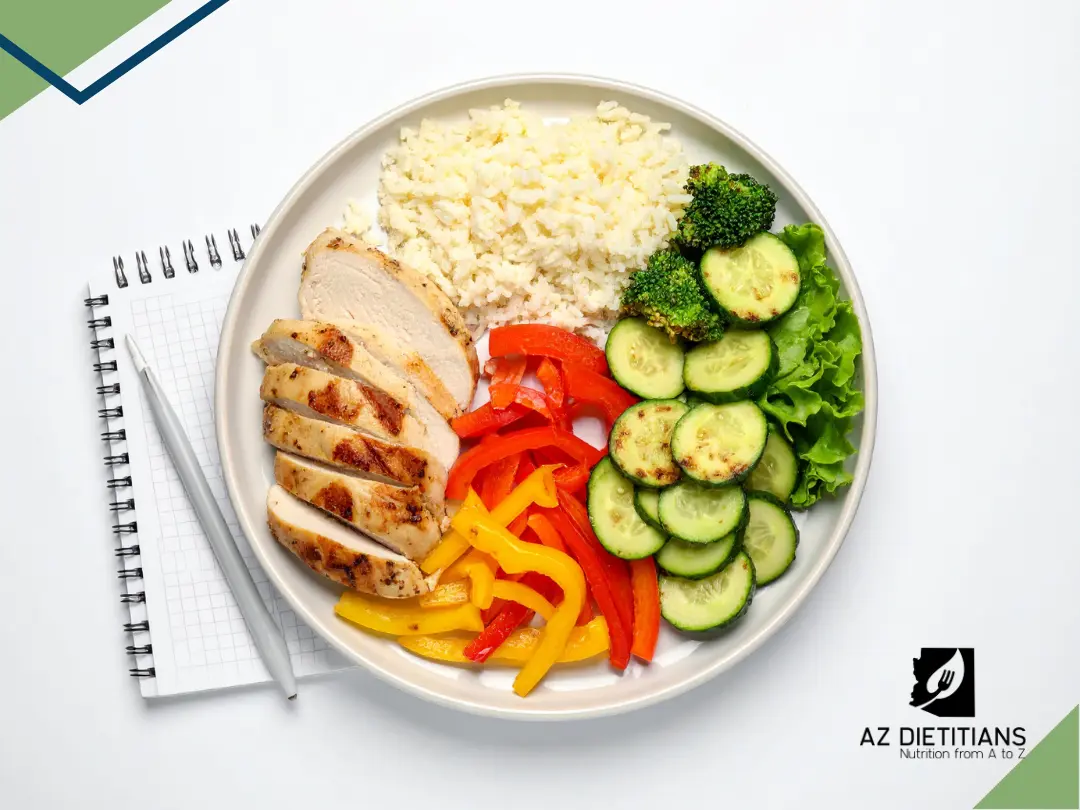
MyPlate is basically the new version of the Food Guide Pyramid. MyPlate takes the foundations of the old Food Guide Pyramid and applies it to show how to build each meal on a plate. The plate is broken into sections like a fraction and each section shows how much of the plate it should take up.
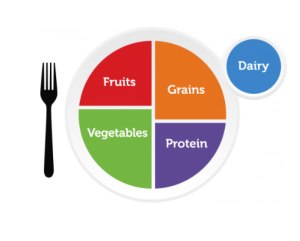
The general recommendations are to make half your plate fruits and veggies, focusing on whole fruits and non-starchy veggies. About a quarter of the plate should be a protein source and the other quarter should be a grain, specifically from whole grains. MyPlate is also customizable based on dietary needs, preferences, and budget.
Using MyPlate to Create a Balanced Eating Plan
Lets Go Through Each Category:
Fruits
This includes fruit and 100% fruit juices. Fruits can be fresh, frozen, canned, or dried. However, at least 50% of the recommended amount of fruit should be from whole fruit. The recommended amount of fruit per day depends on age, sex, weight, height, physical activity, etc.
General recommendations:
- Toddlers: ½-1 cup per day
- Kids 3-8: 1-2 cups per day
- Adults: 1 ½ – 2 ½ cups per day
Examples:
- 1 apple = 1 cup
- 1 large banana = 1 cup
- 1 cup of berries
- 20-22 grapes = 1 cup
- 1 large orange = 1 cup
*Servings can be spread throughout the day
Veggies
This includes any vegetable or 100% vegetable juice. Vegetables can be raw or cooked, fresh, frozen, canned, or dried. Vegetables are broken into five subgroups: dark green, red/orange, beans/peas/lentils, starchy, and other. The recommended amount of veggies per day depends on age, sex, weight, height, physical activity, etc.
General Recommendations:
- Toddlers: ⅔-1 cup per day
- Kids 3-8: 1-2 ½ cups per day
- Adults: 2 ½ – 4 cups per day
Examples:
- 1 cup broccoli
- 1 cup baby carrots
- 1 cup peas
- 1 large bell pepper = 1 cup
*Servings can be spread throughout the day
Grains
This includes foods made from rice, wheat, oats, cornmeal, barley, or other cereal grains. There are two groups of grains, whole grains and refined grains. At least 50% of grains we eat should be whole grains. The recommended amount of grains per day depends on age, sex, weight, height, physical activity, etc.
General Recommendations:
- Toddlers: 1 ¾ – 3 oz-equivalents (1 ½ – 2 oz coming from whole grains)
- Kids 3-8: 3-6 oz-equivalents (1 ½ – 3 oz coming from whole grains)
- Adults: 6-9 oz-equivalents (3-4 ½ oz coming from whole grains)
Examples:
- 2” mini bagel = 1 oz equivalent
- 1 slice of sandwich bread = 1 oz equivalent
- ½ cup cooked oatmeal = 1 oz equivalent
- ½ cup cooked rice = 1 oz equivalent
*Servings can be spread throughout the day
Proteins
This includes animal meats, poultry, eggs, beans, peas, lentils, nuts, and soy products. You may recall that beans, peas, and lentils are part of the vegetable group too. Meat and poultry choices should be should be lean or low-fat, such as 93% lean ground beef. The recommended amount of protein per day depends on age, sex, weight, height, physical activity, etc.
General Recommendations:
- Toddlers: 2 oz equivalents
- Kids 3-8: 2-5 oz equivalents
- Adults: 5-7 oz equivalents
Examples:
- 1 oz cooked ground beef or pork = 1 oz equivalent
- 1 egg = 1 oz equivalent
- 12 almonds = 1 oz equivalent
- ¼ cup cooked beans = 1 oz equivalent
Dairy and Fortified Soy Alternatives
This includes milk, yogurt, cheese, and fortified soy products. It is important to note that this does not include milk products with high fat content like butter or heavy cream. The recommended amount of dairy per day depends on age, sex, weight, height, physical activity, etc. (1)
General Recommendations:
- Toddlers: 1 ⅔ – 2 cups
- Kids 3-8: 2 – 2 ½ cups
- Adults: 3 cups
Examples:
- 1 cup milk
- 1 cup yogurt
- ⅓ cup shredded cheese
Overall, MyPlate is a useful tool for creating balanced meals. It isn’t about strict rules, it is a flexible guide to help you make smarter choices at each meal. This approach supports portion control, variety, and mindful eating without the use of strict diets.
References:
U.S. Department of Agriculture. (2025). MyPlate. MyPlate; U.S. Department of Agriculture. https://www.myplate.gov/
Written By: AZ Dietitians
Published: January 12, 2026
Last updated: February 5, 2026